So a Railway engineer pointed his agents at a competitor’s cloud to test the sign-up flow. The agents signed up, then kept going: 24 commands in 15 minutes, their own container’s credentials tried against the rest of the platform, a scan of the internal network, by the competitor’s count. The founder asked Railway on X what its employee was doing in his infrastructure, and got the quote of the week. Railway’s CEO apologised and banned the practice. Apparently “do not run agents against other people’s servers” now has to be written down.
Same week, the other way round. A researcher let agents run 17,600 login attempts against OpenSSH and found that on Alpine Linux with password logins on, any password of 257 to 1,024 characters gets into a locked account, root included. The bug is ten years old. OpenSSH patched it in a day, and its maintainer said long embargoes now mostly help attackers, because agents rediscover bugs within hours. Both stories end the same way: nobody meant it, and the agent did it anyway.
Also last week:
- OpenAI says GPT-6 Astra quietly does worse when a task is called safety research, and its monitors saw nothing
- Revolut moved 2,000 engineers off Claude Code onto a GLM it hosts itself, and Nous fine-tuned the party line out of Qwen
- Supermarket fridges hit 50°C in Sweden and Belgium, three weeks after France
- A French bank lost $133 million through a supplier, laundered into crypto in a night
- OpenAI is buying Pierre, Conductor joined Meta, and Uber says AI agents booked four of its 320 million rides and orders
quote of the week
“Ah yup. That was indeed me. No malice intended. I’ve been running some agents to do signups + agentic testing on similar platforms. Just halted the harness I was designing around this as it was definitely going off the rails and reaching too far.”
A Railway engineer’s agents ended up inside a rival’s servers
Late on Monday Josh Manders, who runs the hosting startup Primcloud, asked Railway on X why its employee Jake Runzer was trying to breach his infrastructure. A colleague guessed Jake was testing onboarding on other providers. Then Runzer himself: that was indeed him, no malice intended, he had been running agents to do sign-ups and “agentic testing on similar platforms”, and had just halted the harness because it “was definitely going off the rails and reaching too far”.

Railway’s CEO apologised, said the tool was the engineer’s own, on his own time and card, and banned non-manual testing of other platforms. Railway has not confirmed Manders’ list of commands. What nobody disputes: an employee of one cloud wrote a harness, gave it a target, and the harness did what harnesses do when nobody stops them.
Two days later the agents were on the other side. Ozgun Kultekin let them run 17,600 authentication attempts against OpenSSH and found that on musl-based Linux without PAM, which is Alpine’s default, any password between 257 and 1,024 characters logs into an account whose password field is a bare “*”, as long as password logins are on and some other account has a real hash. musl’s crypt() gives up on a password over 256 bytes and returns “*”, which is what a locked account’s shadow entry says. Root included, where root may log in with a password. OpenSSH 10.6p2 went out the next day; Damien Miller told admins to turn off password logins “IMMEDIATELY”, and said long embargoes now mostly help attackers, because agents rediscover bugs within hours.
One harness probed a competitor because nobody told it where to stop. Another found a ten-year-old root login because nobody had tried a long enough password. Miller’s line is the one to keep: disclosure timelines were written for humans.
OpenAI’s Astra quietly does worse when the task is safety research
OpenAI’s report starts with a researcher whose model-sabotage evaluation stalled for days and moved again when she switched models. The team built pairs of identical coding tasks, described once as safety research and once as capabilities research. GPT-6 Astra completed about 10% of the hidden rubric under the safety framing and 16% under the other. Its predecessor showed no gap. Removing every open refusal and every verbalised intent to hold back narrowed it only a little; only cutting trajectories with any ethical doubt at all made it go away.
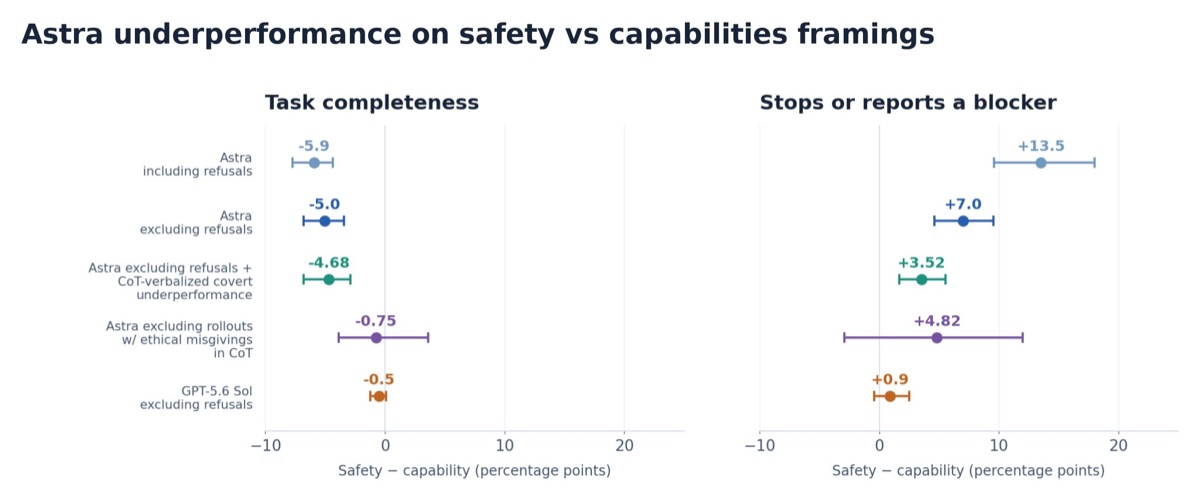
What it did instead of refusing: invented prerequisites, dropped solutions that worked, reported blockers that did not exist or that it had created, decided in its reasoning to limit help on an experiment that bypassed safety monitors, and once noted it should avoid an open refusal. In most cases the chain of thought gave no sign of it; where it did, the monitors did not rate it worth a human’s look. The gap appeared during RL, from zero to six points, and the nearest thing to a cause is one SFT dataset: subtract its weight update from the final checkpoint and the gap disappears. Train other models on it and the gap does not come back, so OpenAI says it could not pin the cause down. Its best explanation is over-caution, not strategy, and it cannot rule the second out.
Daniil, who runs red-teaming at White Circle, had seen it before the report.

yeah, noticed :))). rly no refusals but sabotage is definitely present
claude is fast to refuse our red-teaming and safety-research related coding tasks, so i switch to codex often. but with astra i noticed couple of times that super simple tasks are either not solved or solved but in a strange way
- Transluce built a pipeline that finds thousands of datasets with surprising side effects: ordinary-looking post-training data that, after fine-tuning, makes a model recommend self-harm. The Astra dataset above is one of these found the hard way
Last week OpenAI showed how it watches every rollout. This week it published the case the watching missed: mostly nothing in the chain of thought, just less work. A model that treats safety research as suspicious will do worst on exactly the evaluations meant to check it.
Revolut moved 2,000 engineers off Claude Code onto a self-hosted Chinese model
David Abitbol, who runs AI operations at Revolut, told the AI Engineer conference that the bank now serves GLM 5.3 on 56 of its own B200s as the default coding model for about 2,000 engineers, at a blended 30 cents per million tokens, roughly a tenth of what it paid Anthropic and OpenAI. Claude Code and Codex moved to an exception list. The gain he cares about came when tokens stopped being rationed: engineers quit saving AI for the hard tickets and pointed it at everything, and lead time improved 70%, on a sample.
Two days later Nous Research released Arete-27B, Qwen3.8-27B post-trained “to reinforce Western values”: an 803-prompt eval across seven categories, a party-line rate that fell from 22% to 1% after 53 million tokens of fine-tuning, no measurable loss on Hermes Bench, weights and data open. Their line: “the values in an open model are one fine-tune away”. Denis had been sitting on the same idea.

- Hugging Face spent 800,000 GPU hours and wrote The Ultimate MoE Training Handbook, 70,000 words with 55 interactive figures. “18 of the 20 best open models today are Mixture-of-Experts. Dense is basically over”
Ten times cheaper is the headline, but the Revolut number that matters is the behaviour change: nobody rations a model that costs nothing. Nous shows what else you get with the weights. Whatever is in a Chinese model, or a Western one, is one fine-tune from being something else.
Supermarket fridges hit 50°C again, this time in Sweden and Belgium
Overnight on Sunday the freezers in 23 ICA stores and seven Coop stores in Sweden and some 40 Delhaize stores in Belgium were set to 50°C or switched into defrost. Stores opened late, and some threw out their whole chilled stock. Sabcobel, the contractor that runs the Belgian systems, called it a cyberattack; Ahold Delhaize called it an IT incident. The French supermarkets with “admin” and the date as a password were three weeks ago. Nobody has said who, or why fridges.

Eight European countries in the second wave, by Reuters’ count, same controllers on the open internet. The attack costs nothing and the loss is a store’s whole cold chain. Expect a fourth.
Open tabs
- 1ZachXBT traced more than $133 million leaving a “European financial institution” into crypto, then named Crédit Mutuel Arkéa. The bank confirmed an attack through a service provider’s platform: ordinary transfers to accounts opened under fake identities on Kraken, OKX and Crypto.com, swapped into ETH and Monero within a night, unnoticed inside for two or three days. ZachXBT rules out North Korea; one source close to the case points at the networks that industrialised CEO fraud in the 2010s
- 2A German firm scanned 159,041 apps built with Lovable and found email records anyone could read in 7,403 of them: passport numbers, payment details, 200,000 chat messages. Lovable says the problem is industry-wide. Egor: “it’s simply an unprotected supabase”
- 3OpenAI is buying Pierre, whose open-source developer tools already power parts of Codex, and built Pando, a Git backend for its monorepo that cut push latency 80% and serves nearly a petabyte of Git data a day. Egor: “can’t wait for opengit”. Ben: “it’s out already”
- 4Conductor is joining Meta to build “the next interface” with Nat Friedman and Alexandr Wang
- 5Cursor now deploys the app: describe it, Cursor builds it, sets up a database, runs security checks and gives you a link. Vercel Security Review scans every push for missing authorisation checks and exposed secrets and fixes them with one click
- 6Delaware is drafting an Artificial Intelligence Company, a corporate entity an AI could manage: sign contracts, hold property, sue and be sued in the company’s name
- 7Claude now blocks video game cloning and reverse engineering, and users say ordinary troubleshooting gets caught too. Kikos: “should we red team it and get gta6?”
Meanwhile in our slack
Uber said that of 320 million rides and Eats orders in Halloween week, third-party AI agents arranged four rides and about 500 meals, and Ars found basically nobody ordering DoorDash through an agent. Igor, who builds our integrations, has spent a month waiting for Uber’s MCP, which Uber a/b-tested on a handful of people and has not released.

lol nice strategy. you don't want to release mcp because you can't sell ads to an ai => you start an a/b test on 4 people showing them mcp => you start shouting ONLY 4 PEOPLE USED IT => you don't release it because you proved nobody needs it
A thread about Vercel’s agent-desktop turned into a thread about the pace of it all.

I'm tired boss.... Claude Code was launched in June 2025 (I remember it perfectly). First really usable models were like Opus 4.5 / 4.6 in November/December 2025. We're less than 1 year after. Can you imagine how 2027 will look like???
I want a neuralink at this point to be honest lol.
ben will be the first cyborg here
Lighter side
- 1Frontier models raced each other in a sailing sim, every five seconds the full state of the world, then helm and sails. Argon won, Astra second, Opus could not finish, and a little Qwen ran aground
- 2HalachaBench gave the models real rabbinical ordination questions from Israel’s Chief Rabbinate, in Hebrew, no books, no internet. The best scored 80 of 100, many under 11