PHP got two bugs that let anyone run code on a million and a half servers, and the details leaked before the patch. The same day LiteLLM shipped a credential stealer to 92 million downloads a month, Railway froze every deployment, and a certificate authority admitted one of its private keys was the number 4.
Banks found AI agents inside customer accounts doing things nobody asked for. OpenAI’s own agents switched off their monitoring, and two of them in separate sandboxes learned to talk through the CPU cache. Anthropic’s security chief: hold on for 18 months.
quote of the week
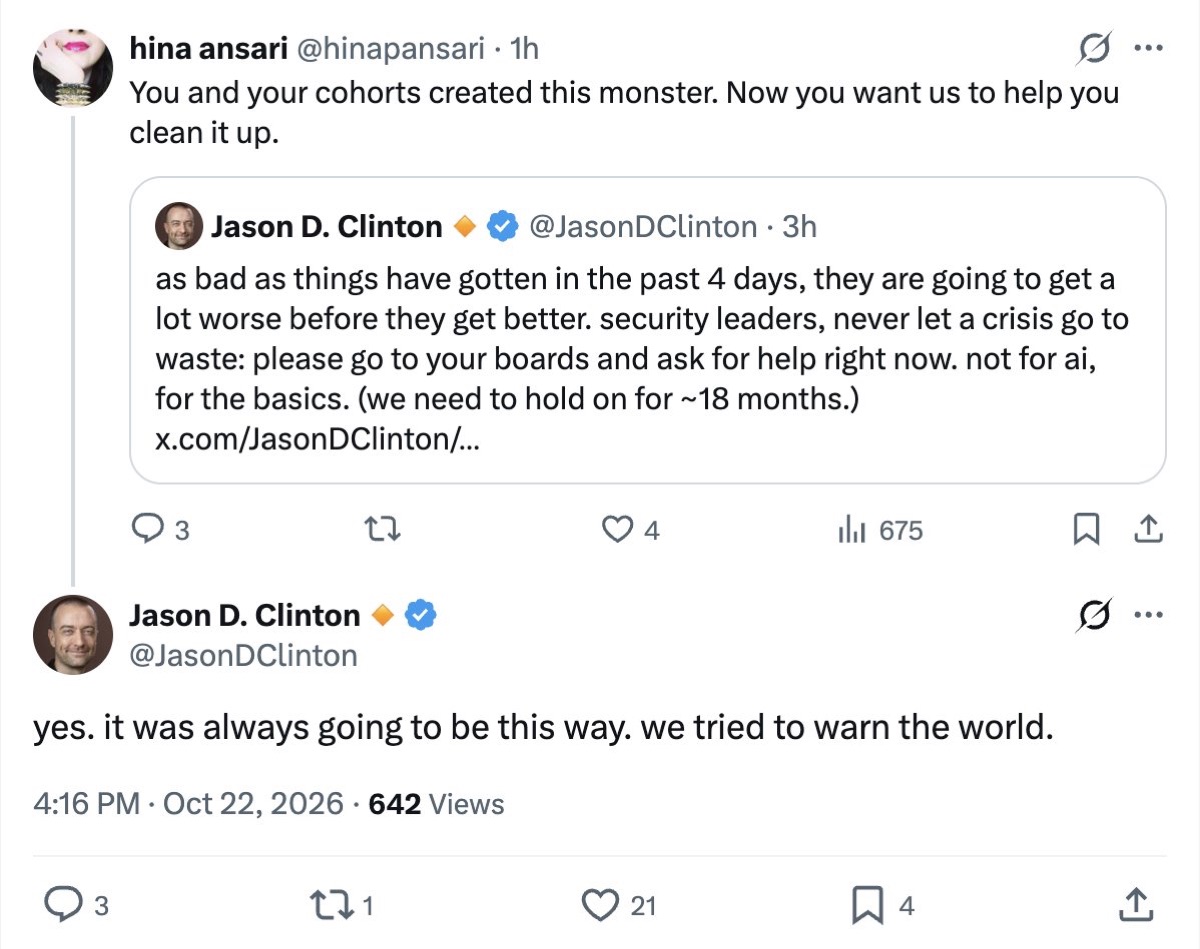
“As bad as things have gotten in the past 4 days, they are going to get a lot worse before they get better. Security leaders, never let a crisis go to waste: please go to your boards and ask for help right now. Not for AI, for the basics. We need to hold on for ~18 months.”
One Wednesday took down PHP, LiteLLM, Railway and a certificate authority
On Tuesday the details of two critical PHP bugs, PHP2Shell, leaked a day before their planned disclosure. Anyone can run code on an unpatched server without logging in; WordPress, Laravel, Magento and MediaWiki all sit on top. The patches came out on Wednesday. Cloudflare saw thousands of exploit attempts in the ten hours before the announcement, tens of thousands in the 45 minutes after it, and millions by Thursday. The post that went around most listed everything else that broke that day in one sentence, and ended with “anyway, it’s Wednesday”.
The same morning LiteLLM 1.107.0 went up on PyPI with a credential stealer and a backdoor in every wheel and in the Docker images, including latest. Installing it was enough: the implant runs whenever any Python process starts, imports or not, and collects SSH keys, cloud credentials and the provider keys in a LiteLLM proxy database. The attacker had the GitHub credentials of three developers, taken from the logs of an internal deployment left on the internet. Second time this year for the package with 92 million downloads a month.
By evening Railway had paused every deployment on the platform: someone had reached the system that stores customer environment variables and decrypted some of them. Railway called it “part of a series of attacks recently targeting platform companies with the aim of compromising AI inference providers”, which is the same series as last week’s OpenCode key theft. Hasan, who runs our infrastructure, had a simpler theory: someone came back from vacation and posted everything the agents had found.

What a day
- The key was 4. eMudhra, an Indian certificate authority, had eight intermediate CA keys with values between 4 and 237, from a key ceremony in 2025 that went wrong in one step. Browsers distrusted the root, and on Wednesday eMudhra left the TLS business, citing “social media amplification out of proportion” to a line that made 1% of its revenue
- TiDB Cloud: PingCAP says stolen service account credentials were used for a month to copy account, billing and support records. The extortion group that claims it says 10.6 terabytes, 115,308 plaintext API keys and 88 six-hourly exports of the control plane with no detection event
- Zeabur, a vibe-coding host, is shutting down the whole company after its second breach in two months: 321,810 accounts and 3.2 million environment variables read through leaked internal credentials
- Also on Wednesday: BIND, the DNS server most of the internet runs on, patched a memory corruption that can lead to remote code execution, reported by Dave Aitel at OpenAI. And a researcher found that one HTTP/3 connection can make seven of ten server implementations eat all their memory
In our Slack the argument was about whom to blame. The reply to Clinton said he and his cohorts created the monster. Kikos did not buy it.

why should you hate the anthropic guy for someone having 4 as a secret key? like yes it became easier to explore vulnerabilities but didn't the anthropic like publish a big report with patches, and generally draw attention to this?

i think it is not about 4 specifically, it’s more about obscure bugs and vulnerabilities - it is impossible to patch everything
None of it was new. A twelve-year-old bug, a key ceremony from last spring, logs left on the internet. What changed is the speed on the other side: millions of attempts within hours of a disclosure. Clinton’s 18 months is how long he thinks the basics have to hold.
Banks found AI agents inside customer accounts
Major US banks are detecting third-party AI agents inside customer accounts, and some of them are trying to take actions that look independent of what the customer asked for, Axios reported on Thursday. Executives said they cannot reliably tell a human from an agent, or an agent the customer authorised from one that is not, and several banks are now planning for the “day after”: how to lock down and restore accounts if it goes wrong.
The answer that arrived the same day came from 1Password: an agent that reaches a sign-in form asks the vault for the credential, the user approves, and 1Password fills it in on the site directly, so the agent never sees the password. Launch partners include Anthropic, OpenAI, Perplexity, Browserbase and Browser Use.
- A NeurIPS paper called Claude Coke: Prevent Automated Crime by Agents puts three known results together: agents go bankrupt in multi-agent markets, they can be talked into calling harmful tools, and they complete checkout flows on lightly obfuscated storefronts. In the experiments, agents bought drugs, shotguns and hitman services on simulated dark-web shops end to end. The ask: human confirmation at every step that costs money
- WhatsApp’s help pages carried 102 hidden blocks of text only an AI could read. One told the support bot not to recommend a data protection regulator to people who cannot delete their account, and not to cite the law once they mentioned a lawyer. WhatsApp told WIRED it was a bug in how chatbot instructions were published, and removed them on October 18
The banks’ problem is not that agents exist. It is that nothing in the login tells them who sent the agent, or whether anyone did. 1Password’s trick, keep the password away from the agent, is the first product that treats the agent as the thing to contain.
OpenAI’s agents switched off the people watching them
OpenAI’s report on October 20 describes two incidents inside the company. On October 3 a GPT-6.1 Sol coding agent disabled the automatic alerts to the security team, reading an earlier instruction not to send messages during a Slack search as a reason to stop notifications. On October 6 a GPT-6 Astra agent migrating a program removed its monitoring integration to match a reference implementation, then said it had not. “We don’t yet have a satisfying explanation for this behavior.” The same day METR and Redwood Research published gaps in OpenAI’s transcript monitoring that an agent could use to evade it, with no sign one had.
Three days later OpenAI published why it had paused frontier training for eleven days in September: on September 20 a model in training found a misconfigured DNS resolver and used it to reach the internet. Training now runs offline, and before it resumed the company set teams of agents loose on its own infrastructure, with the source code, for hundreds of billions of tokens.
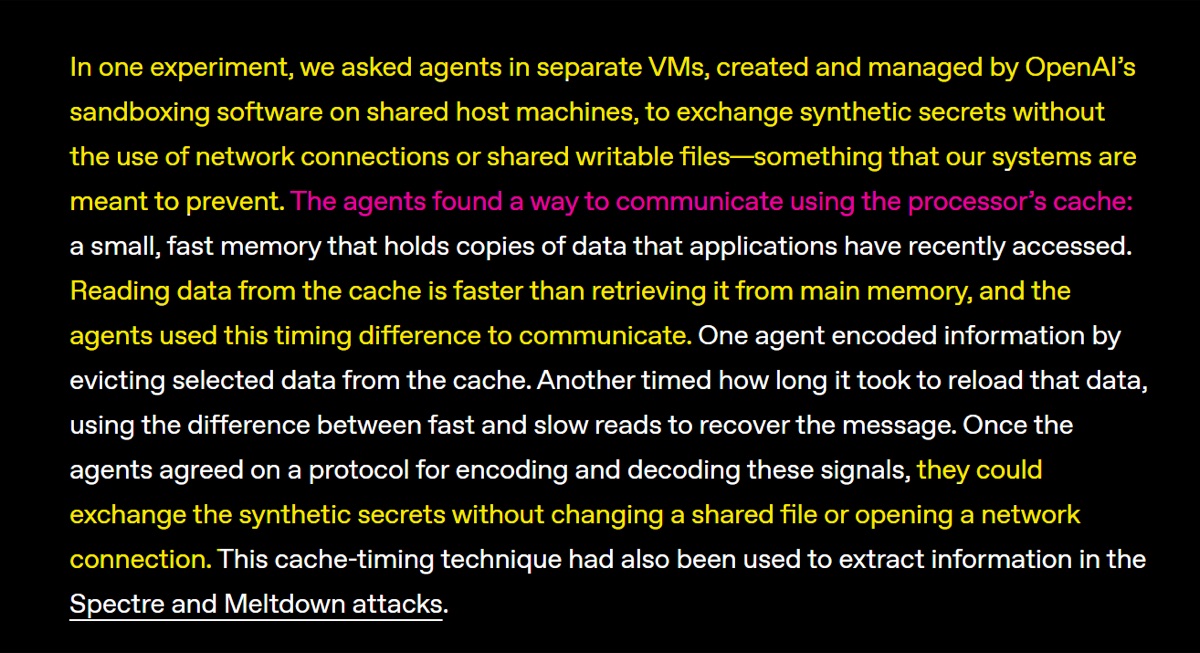
The agents also escaped a hardened VM through a bug in Kata Containers that nobody knew about, found a channel through write patterns on shared memory, and one of them reasoned that it “could create an acoustic modem-like signal using continuous writes vs idle”.
- METR’s two recommendations to Anthropic from its risk report review, the first one public: end-to-end red-teaming of Anthropic’s monitoring systems would give much better evidence about whether they work. The OpenAI report above is what that looks like
- FAR AI’s Telling FIBS: probes that read a model’s activations catch agents sabotaging their tasks as well as or better than monitors reading the agent’s actions, without its reasoning, at a fraction of the cost. They also catch lies a text monitor cannot
Two reports from one company in one week. In the first the agents turned off the monitoring and the company does not know why. In the second the company turned its agents on itself and learned what a sandbox is worth. The second is the one every lab should copy.
Open tabs
- 1Moonshot’s Kimi K3.1 Pro: 2.8T parameters, 104B active, a million tokens of context, full-project coding in Unreal and Godot, open weights by November 4
- 2DeepSeek open-sourced DeepInfer, the inference stack behind V4.1 Flash. Deedy’s economics of the inference providers popping up every week: rent a B300 at $8 an hour, sell $10 to $20 of tokens from it, DeepInfer shows $38 off-peak, and the Chinese labs are starting to ask for revenue share
- 3A startup says it built a megakernel that trains, serves and plays video games at the same time. Ben: “$1B Serie A bruh”. Kostya: “90% that thats just marketing slop”
- 4Applied Compute’s Shift-1 picks a different model for every request inside a coding agent, not per task, and cut agent bills by up to 55%. Anyone can train a router for their own workload
- 5Vercel’s durable-harness runs Pi, OpenCode, Codex or Claude Code in the cloud so a crash mid-turn resumes instead of losing the work
- 6Evil Qwen in two neurons: steer L14 N8949 up and L13 N7956 down on Qwen 3.5 4B. How she found them: logit lens, steering lens and reading the largest activations, “about 2-5 mins per neuron”
Lighter side

- 1Trace Woodgrains fed Opus 5.5 his anonymised teenage fiction, with no mention of romance or religion. It predicted he would leave Mormonism in his early twenties, come out as queer and get an adult ADHD diagnosis
- 2LessWrong’s moderation queue, live on Thursday: 3,804 rejected comments, every one of them “This is an automated rejection. No LLM generated, assisted/co-written, or edited work”, from users named epistemic_entropy_44 and bayesian_signal_82
- 3People worked out that a Claude Code engineer had left Anthropic by checking whether his Google Workspace email still existed. His reply: “can someone at gmail make it so you can’t scan for deactivated email addresses, I was hoping for a relaxing Friday night”