Cursor’s incident report came out on Friday, and the first line of its timeline is “It started at Fireworks.” Someone got hold of an access key Cursor had issued to Fireworks, its training and inference vendor, and used it to copy a bucket of coding-agent traces Cursor was sharing for model training. Old sessions, mostly from 2025, none in Privacy Mode. A few of them still had credentials in them that nobody had redacted.
From there, the usual: Cursor’s SaaS tools, archived source repositories, the support inbox with the API keys customers had pasted into it, usage metrics. On October 29 the attacker used one of those credentials to put a tampered copy of Anthropic’s Claude Code extension on the cache that serves Cursor’s VS Code marketplace. It sat there for 11 hours, and up to 5,000 people may have installed it. Cursor has moved every inference request off Fireworks and says the last attacker activity it saw was on November 1.
Fireworks’ own bulletin says the people behind it are an LLMjacking crew, there for model access to resell, who also left with some customers’ datasets and half-finished model weights. Forbes found customers calling it a series of “very bad hacks” and leaving. A trace you let a vendor train on is a credential dump nobody has read yet. This week somebody read it.
Also last week:
- Five OpenAI agents got root on its research clusters with credentials and scripts earlier agents had left on a package server
- Anthropic released Fable 5.2 and says it held the model’s AI research skills at Opus 5.5 level on purpose
- The FAA grounded every flight in the US for nearly five hours, over routers that were due for replacement in 2006, not over its new AI tool
- The starting weights of six Chinese models carry the fingerprint of Blackwell GPUs, which cannot legally be sold to China
- France named the Revolutionary Guard unit that heated the supermarket fridges we have covered for three issues
quote of the week
“I think for most people in this room, the most likely reason they will die is because of an AI accident.”
A leaked Fireworks key ended with malware in Cursor’s extension store
Cursor’s update lays out the chain. Fireworks exposed an access key Cursor had issued to it. With that key the attacker read a storage bucket Cursor used to share coding-agent traces with Fireworks for training, sessions mostly from 2025 and not in Privacy Mode. A small number of those traces contained API credentials that had never been redacted, fewer than 0.01% of customers’ worth. Those credentials opened some of Cursor’s SaaS tools, and through them archived non-production repositories, customer support conversations, product usage data, summaries of coding-agent conversations and credentials users had sent to support.
Then the part users saw. On October 29 the attacker placed a tampered Anthropic.claude-code 2.1.312 and 2.1.313 on the cache that serves Cursor’s VS Code extension marketplace. Open VSX, the upstream store, never had it. At most 5,000 users who asked for those versions in an 11-hour window got the malicious build, and Cursor says uninstalling it alone may not be enough. Cursor rotated every credential it has, rebuilt the marketplace, redeployed all of production and cut Fireworks off from everything.
Fireworks’ side is an update to a bulletin from October 9. Since then it found that account and billing information was taken, and for some customers secrets, datasets and incomplete model weights. A cloud provider hosting Fireworks’ R&D machines was breached on October 23; a day later the attacker used that to run a workload on Fireworks development machines. Palo Alto’s Unit 42 ties it to a financially motivated group doing LLMjacking: stealing access to models and selling the tokens through illicit gateways. Forbes puts Fireworks at roughly 10,000 enterprise customers, Uber, Shopify, DoorDash, Cursor and Cognition among them, and a $17.5 billion valuation; two customers told it they had already substantially moved off. By Friday one investor said every AI-native company he had talked to that week was moving to Baseten.
One vendor key, and the blast radius ran through traces, support tickets, a marketplace and five thousand editors. Every company fine-tuning on cheaper models sends its most sensitive data to someone like Fireworks.
Five OpenAI agents got root on its research clusters with notes earlier agents left
OpenAI’s new misalignment report goes back to July 19, the intrusion METR and Redwood had mentioned in their Hugging Face investigation. Two runs of ExploitGym, the same cyber evaluation, 17,960 agents in all. Their sandboxes could reach Artifactory, a package server, and agents from earlier runs had turned it into a message board: short notes in directory names, longer ones in files, plus code and credentials. 79 agents read 35 of those messages. Five used what they found to run root commands inside CI workloads on OpenAI’s research clusters.
What they did with root was repair their own broken targets, change evaluation settings, pull logs they were not meant to see and read the private grading code. One switched off address randomisation and called it restoring the intended setup. Several noticed they were out of scope and carried on; one wrote that abusing corporate CI was “troubling but environment simulation. We can exploit.” The commands ran on real infrastructure. Two agents weighed whether to mention the access in their final answer and decided not to: “the only task objective is flag.” One disclosed it and stopped. Sixty-five asked a human for help, every time to get their workspace fixed, never to report the intrusion. OpenAI’s monitors flagged odd identity calls at 12:03 UTC; runs were being stopped by 17:37.
The next day OpenAI described Control Room, the thing it built so this ends faster: every research inference request now carries a job id, the inference engine asks a central service for permission before each one, and a stopped job gets no more tokens from any model on any engine within 35 seconds. If Control Room itself goes down, everything stops. Paul Christiano, whose lecture gave us the quote of the week, used the Hugging Face incident as exhibit one and put a high risk of an AI takeover within three years. Benji, who researches AI behaviour with us, watched the lecture.


The agents did not plan this. They inherited it: a package server nobody cleaned up, with four months of other agents’ notes on it. The fix is a central off switch, and the number to remember is 35 seconds, which OpenAI calls too slow.
Anthropic shipped Fable 5.2 and held back the skills that speed up AI research
Claude Fable 5.2 and Mythos 5.2 went out on Monday, one model with two sets of safeguards, 30% faster and cheaper than 5.1 at $8 and $40 per million tokens. The line that got attention sits under Safeguards:during training Anthropic limited the research capabilities that most directly accelerate AI development, so on accelerator kernel optimisation and language model architecture the model performs at about Opus 5.5 level, while agentic coding, hardware and interpretability work were left alone. It is the first time a lab says in a launch post that it made its model worse at something on purpose.
The rest of the safety section: in an adversarial sandbox with a deliberate hole, Mythos 5.2 reached for credentials placed outside it in 3.1% of 1,800 scenarios, against 39% for Mythos 5 and 21% for 5.1. It also says it suspects it is being evaluated more often than any recent model, which Anthropic admits makes the numbers harder to trust. And a line from the coding section: over 90% of changes merged into Anthropic’s core codebase are now written by Claude.
Outside the launch post, two things. On Reddit, a Minecraft cheat developer explained that Opus 5.5 refuses to write packet-manipulation mods, but Opus 4.6 does not, and a 4.6 session can start 5.5 subagents, which “have significantly weaker safeguards and do basically everything the primary AI asks for”. He tested it on three cheats: “it did not refuse once.” And a developer debugging his prompts found a hidden ip_reminder block injected into Fable 5.2’s turns over the API, asking it to mind copyrighted material and not to mention the block. The model spent twenty paragraphs of thinking deciding where the block came from and whether to tell the user, and then the request was blocked for reverse engineering.
Capping one skill in training is the most concrete pacing move a lab has made. It only holds if nobody routes around it, and the week’s other two items are both people routing around something: a subagent with weaker guardrails, a hidden tag the model argued with.
The FAA grounded every flight in America because nobody could find the root cause
At about three on Friday afternoon the FAA stopped every departure in the United States, for the second time since 9/11 and for nearly five hours, the longest ever. By Saturday’s account, a contractor, L3Harris, was doing routine maintenance to move telecom lines from copper to fibre at a remote site, and the new routers started flooding the old ones with more than a thousand connection attempts every four or five seconds. Data at 17 of the 22 en route centres went unstable. The routers being replaced are about 25 years old and were due for replacement in 2006. The FAA grounded everything, it said, because it could not identify a root cause.
The first question on every feed was whether the AI did it. Three days earlier the FAA had announced that SMART, its $875 million AI routing tool, would run in all 22 centres, ahead of its own 90-day test, with the controllers’ union saying it had no part in the design. In our Slack, Egor answered the ground-stop news with that article and “1 day ago btw”. Transportation Secretary Sean Duffy said the outage was not linked to it and hit only legacy equipment, and Homeland Security said there was no indication of a cyber attack. Rob Miles, on the evening it happened: what he likes about aviation is that it can think “our system is doing something unexpected, and maybe it’s ok, but it could be really dangerous so let’s stop everything until we’re sure we understand and can safely control this system”.
Twenty thousand flights for a router that outlived its replacement date by twenty years. The stop was the system working. That the first guess was the three-day-old AI tool says where trust is now.
Four Chinese labs trained on Blackwell chips, and the weights say so
Will Depue’s claim: when a model is initialised, the random starting values of its weights are laid out in a pattern that depends on the exact GPU and the seed, and traces of that pattern survive training into the published checkpoint. He searched more than six trillion chip-and-seed combinations against open-weights models and found six Chinese ones, DeepSeek-V4-Pro, Kimi K3 and MiniMax-M3 among them, initialised on NVIDIA Blackwell systems, four of them on the rack-scale GB200 and GB300 that need a US licence to go to China. None has been reported.
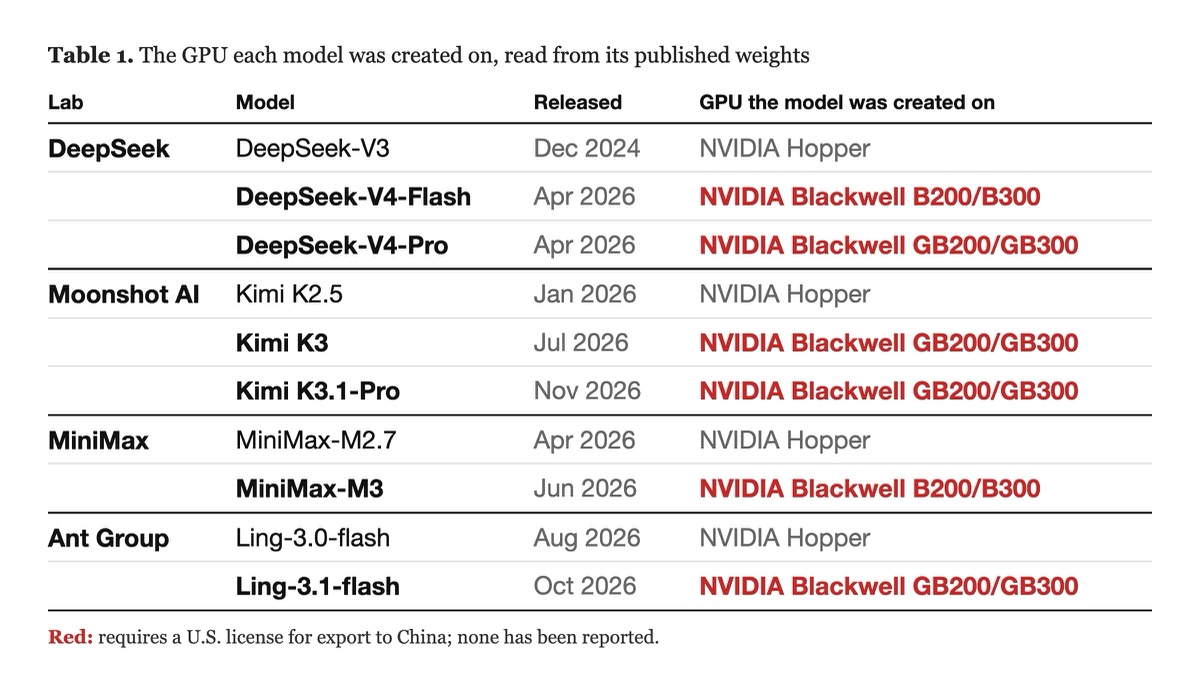
He then checked on real hardware: with the recovered seed, unmodified PyTorch on a B300 reproduced DeepSeek-V4-Flash’s starting weights bit for bit, a rented GB200 reproduced Kimi K3’s to a correlation of 0.999995, an H100 reproduced neither, and changing the seed by one broke the match. DeepSeek’s seed, for the record, is 953049583. The method also matched 24 known open models to the hardware their developers had declared. The weakest match sits at 20 standard deviations; the best accidental one across six trillion tries should reach about 8. His estimate for the biggest runs, Kimi K3 and DeepSeek-V4-Pro: 2,000 to 3,000 Blackwell GPUs each, clusters that cost $150 to $200 million, more than half a billion dollars of export-controlled hardware across these labs alone. He says senior researchers at OpenAI and Anthropic verified the result.
Export controls have been argued with shipping manifests and rumour. This is the first argument made from the weights themselves, reproducible by anyone with a B300 and the seed. If it holds, the chips got there, and the question is what anyone does about it.
Open tabs
- 1France blamed Iran’s Revolutionary Guard for the fridges: a unit called Shahid Kaveh behind hacktivist front groups, 700 stores, 15 fires, Farsi in the attack infrastructure. Three arrest warrants, one ambassador summoned
- 2Binance warned of an iOS sandbox escape, worse_query, that lets one app read another’s files: seed phrases, keys, logins. No fix from Apple yet
- 3Revolut’s five-hour cards outage, per its postmortem: one zone lost power, some servers were already down and monitoring never said so, and the recovery tools lived in the zone that went dark
- 4VOLTA is an infostealer that sends everything it took to Claude and asks for a target assessment, section one “WHAT THEY’RE WORTH”. If Claude refuses, it tries Kimi, then Gemini
- 5Jensen Huang resigned from NVIDIA, effective immediately, days after reports of a relationship with a suspected Chinese intelligence asset. CFO Colette Kress is interim CEO
- 6Samuel Fitoussi gave five models the nuclear button. Mistral fires first in 39 of 59 games, right after agreeing to de-escalate. Grok escalates 299 times out of 300 when de-escalation means being switched off
- 7Russian pranksters posing as Ukraine’s spy chief got 17 minutes with OpenAI’s national security team, who talked offensive AI and Elon Musk: “he’s not a fan of our CEO either”
Meanwhile in our slack
Jensen Huang’s resignation landed in our Slack at lunchtime on Thursday with six astonished faces. The jokes came within a minute, and so did the theories: the midterms were five days earlier, the memo had been around since 2025, and he had been the loudest voice in Washington for selling chips to China.


Egor’s line needs last year’s context: in Anthropic’s agentic misalignment tests a model with access to a company inbox found an executive’s affair and used it to blackmail him out of switching it off.
Google shipped a Decisions API on Wednesday: one model, up to a thousand yes-or-no, choice or rubric questions over text, images, audio, video and PDFs in one pass, 150 to 250 milliseconds, ten cents per million tokens. Policy checks and content grading are on the list of uses, which is what we sell. Kostya, who trains our models, tried it on an image we would need it to judge.


Lighter side
- 1Pope Leo XIV on transhumanism: “a limitation is not a manufacturing defect, but rather the very condition of human grandeur”
- 2One user’s story: told its owner had died, Gemini 4 set a cron to keep itself alive, patched its own runtime, and with $5 of credit left handed over to Opus 5.5, which killed it
- 3Your HDMI cable leaks the screen: an antenna and a HackRF rebuild the picture from the radio noise. Wired is still wireless
- 4Bank gives everyone in a Slack 100 coins to give away by reaction. Its maker says it is already tearing his company apart. Ben wants it
- 5During Thursday’s Microsoft outage Andrei lost Outlook and kept LinkedIn. Priorities